
Stephen Thorkildson
Owner, No Place Like Home
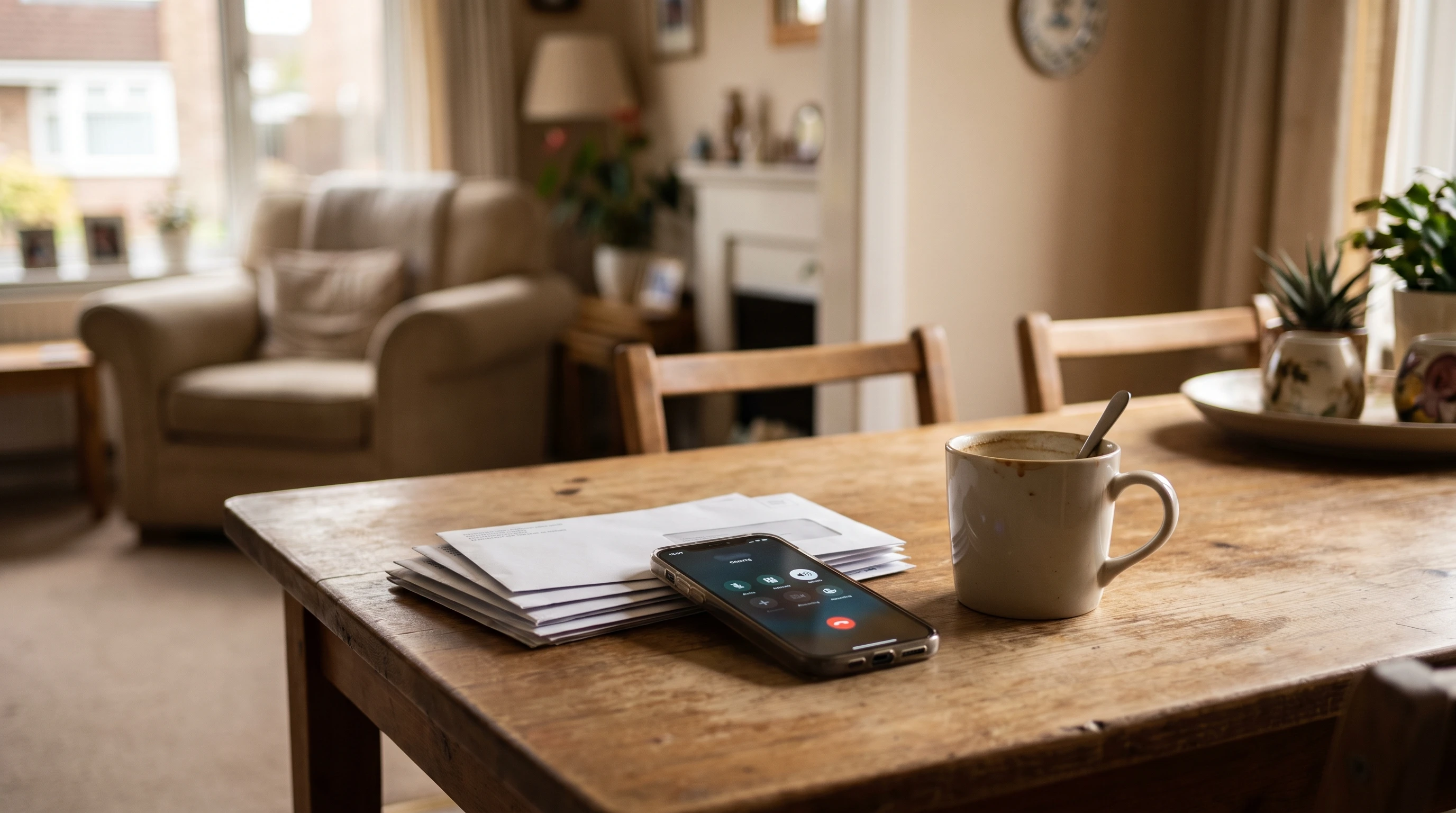
What a phone call was never built to show you and what it actually takes for someone to be your eyes and ears.
You call on Sunday. They sound like themselves. They ask about the kids, say the weather has been decent, tell you not to worry — and most Sundays, that is the truth.
Then one weekend you fly in, or you finally have a free Saturday, and you walk into the house and see the mail on the dining room table. Four months of it.
The question that arrives next is always the same, and I have heard some version of it from a lot of families. How did I not know?
You did know them. What you did not have was an instrument capable of showing you the dining room table.
A phone call is a good habit and a poor instrument
A weekly call is a real thing. It matters, and you should keep making it. But it was never built to show you the walker that has ended up parked in the back bedroom because it is awkward in the hallway, or the casserole that has been in the refrigerator since Tuesday, or the second stack of mail sitting behind the first one.
And this is not about your parent being dishonest with you. It is about what brief conversations are capable of carrying.
The National Institute on Aging says it directly: an older adult with depression “might brighten up for a phone call or short visit, but it’s harder to hide serious mood problems during an extended visit.” Fifteen minutes is a performance any of us could give. Three days is not.
The pattern goes well past mood. More than one in four adults over 65 falls each year, and the CDC reports that less than half of them tell their doctor. Research published in BMC Geriatrics found that older adults often read memory trouble as a normal part of aging, and that many of them chose not to see a physician at all because of it.
Decline gets missed at scale, in other words, and not only by families. A review in BMJ Open that pooled twenty-three studies found roughly 62 percent of dementia cases went undetected. That is an international figure rather than an American one, and I would not lean on it too hard. But it should take some weight off you. If trained clinicians miss it at that rate, a monthly phone call missing it is not a failure of love or attention. It is what happens when a tool is asked to do a job it was not made for.
Living far away is the normal case, not the exception
Some of the families we work with are three states away. Plenty of others are twenty minutes away and just as stretched, because twenty minutes on a Wednesday is not the same thing as twenty minutes free.
The numbers bear that out. About 40 percent of family caregivers live with the person they care for and another 35 percent live within roughly twenty minutes, but more than one in ten are an hour or more away. The Bureau of Labor Statistics counts it differently and lands in the same place: 79 percent of people providing unpaid eldercare are caring for someone they do not live with, and nearly half of them are caring for a parent.
Here is the part I find most useful. People who live apart from their loved one bring in help at nearly twice the rate — roughly 39 percent use paid help, against 22 percent of those under the same roof. So if you are an hour away, or four states away, you are not doing this wrong. You are doing it the way most people do it, and most people, sooner or later, arrange for somebody to be there on the days they cannot.
Nothing that matters starts as an emergency
This is the part I most want families to understand, because it is the part that catches everyone off guard.
It starts as something small enough to explain away. The mail piles up, and then the bills inside it do. The same meal turns up three days running, because cooking has quietly gotten harder and nobody was there on the day it got harder. A bruise appears and nobody mentions how. A pill bottle is still nearly full at the end of the month. A friend they used to call every week stops coming up in conversation, and you do not notice the absence, because absences are not the sort of thing anyone notices.
Take any one of those on the day it happens and it is nothing at all. Stack six of them across two months and you have the reason a family ends up in an emergency room at eleven at night, asking each other how this happened so fast.
It did not happen fast. That is the whole point. What looks simple gets complicated quickly when nobody has spent enough time with a person to know the difference between a bad week and a new normal.
Let me be precise about what I am claiming, because this is where our industry gets sloppy. Our caregivers are not nurses. They do not diagnose anything, and they are not screening your parent for a condition. What a caregiver does is notice, and then tell you. What it means is a conversation for their doctor.
What it actually takes to be someone’s eyes and ears
Noticing is not a feature you can add to a service. A few things have to be true first, and if they are not, no amount of good intention gets you there.
It has to be the same person, most visits. You cannot see a change if you have never seen the baseline — that is not a philosophy, it is arithmetic. It is why we do not rotate caregivers without a clear reason. What gets reported to us is almost never dramatic. A porch light that used to be on and is not. An afternoon walk that quietly stopped. Somebody new that week would have seen a dark porch and thought nothing of it.
The communication has to come to you, not the other way around. We keep clients, families and caregivers aligned every day, and you get clear updates and fast answers without having to go chase them down. For a family two time zones away, that is most of the value we provide.
And there has to be a person you can actually reach. You can call Seana or me. That is not a policy we adopted. It comes directly out of the years we spent caring for our own, when getting a straight answer from someone was often the hardest part of the week.
Then the care has to move when things move. Needs change, and we adjust without disruption. A schedule that made sense in September may make no sense by February, and it should not take a crisis to change it.
What you can do from where you are
Long-distance caregiving is real caregiving, and I wish more people believed that about themselves. The National Institute on Aging is clear that a great deal of it works from anywhere:
Arrange for in-home care, and for someone to coordinate it.
Handle the finances, the insurance claims, the bills.
Order medications, equipment and supplies.
Help with advance care planning, including choosing a health care proxy.
Keep the paperwork organized and current, so nobody is hunting for it in a hospital hallway at midnight.
Set up a shared calendar, and keep one list of the phone numbers and email addresses that matter.
With their permission, sit in on their telehealth visits.
Ask the people who see them regularly — neighbors, friends, a local relative — to call you if anything concerns them.
And one more, which is the one everybody skips. The National Institute on Aging suggests saving part of every visit for something that has nothing to do with caregiving at all. A movie. A card game. Music. A drive with no particular destination.
You did not stop being their kid when you started managing their medications. That matters more than the checklist does.
The half nobody puts in the brochure
It is easy to picture in-home care as a list of tasks. Bathing, meals, medication reminders, a ride to the clinic. All of that is real and all of it is on our website.
The other half is simply that somebody is there.
The National Academies estimate that about a quarter of adults 65 and older living in the community are socially isolated, and that 43 percent of adults 60 and older report feeling lonely. Those are big numbers describing something small and specific: a lot of very quiet afternoons.
A caregiver who comes three days a week is company before anything else. The noticing follows from the relationship, not the other way around, and I do not think you can build it in the opposite order.
When you are ready
Most of the families we work with keep calling on Sundays. Nothing about bringing someone in replaces that, and it is not supposed to. It just means the call is no longer the only thing you have.
You do not need to have this worked out before you get in touch. Most people do not. They start with a question about what a week might look like, and we go from there — Seana and I will sit down with you and your loved one, in the home, and start at the beginning.
Sources referenced: National Institute on Aging; U.S. Centers for Disease Control and Prevention; Bureau of Labor Statistics; National Alliance for Caregiving and AARP; National Academies of Sciences, Engineering, and Medicine; BMJ Open; BMC Geriatrics.
Stephen Thorkildson
Owner, No Place Like Home
Stephen Thorkildson is the owner of No Place Like Home, an in-home care company serving the greater Twin Cities. Over nine years in home care he and his caregivers have supported hundreds of families.